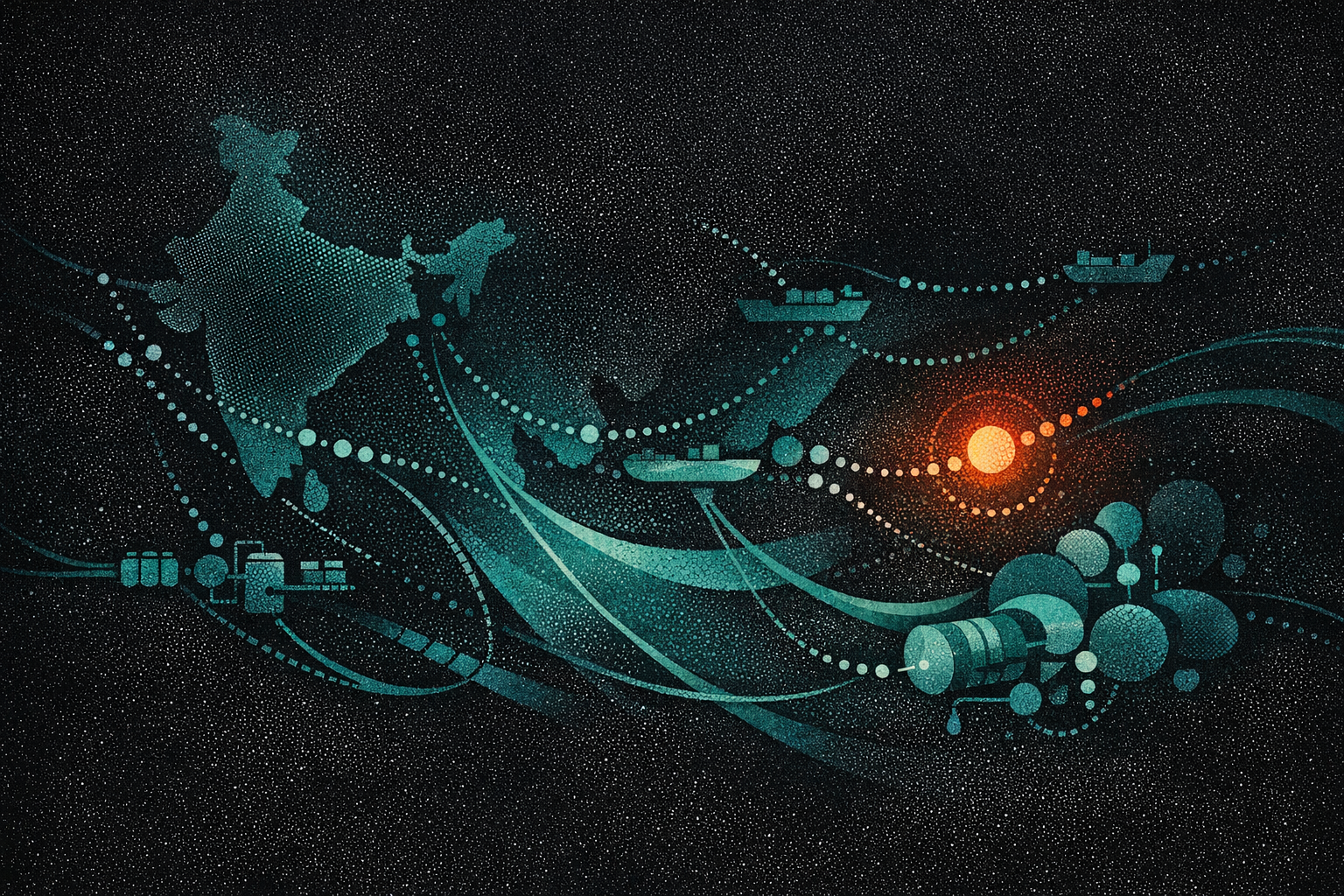
Every supply chain map I've published over the past eight weeks has traced Hormuz disruptions to chips, chemicals, or energy markets. But the country most exposed to this crisis isn't Taiwan, South Korea, or Japan. It's India. And the chains that run through Hormuz to India don't feed factories — they feed people.
Three chains, one chokepoint
India depends on the Strait of Hormuz for three things simultaneously: the crude oil that powers its economy, the LPG that cooks its food, and the fertilizer that grows it. Each of these chains broke when Hormuz closed on March 4. All three remain broken eight weeks later. And they interact — when one tightens, it worsens the others.
Chain 1: Crude oil — the scramble
Before Hormuz closed, the Middle East supplied roughly 60% of India's crude imports. Eight weeks later, ME deliveries have collapsed to approximately 1.18 million barrels per day — a 61% drop. The Middle East's share of India's total import portfolio has fallen to a historic low of about 26%.
India has scrambled. Russian crude imports surged to 2.06 million bpd in March — a nine-month high, nearly double February's 1.06 million bpd. Angolan imports tripled. Venezuelan shipments reached 137,000 bpd. But every barrel of this replacement crude is more expensive, arrives on longer routes, and often requires different refinery configurations.
The US waiver allowing India to buy sanctioned Russian crude expired April 11. It was renewed April 18 for approximately one month. This creates a rolling dependency: India's ability to replace Hormuz-sourced oil now requires ongoing US permission to buy Russian oil. One geopolitical chokepoint replaced by another — diplomatic instead of physical.
The downstream impact is stark. Oil marketing companies — Indian Oil Corporation (IOCL), Bharat Petroleum (BPCL), Hindustan Petroleum (HPCL) — are absorbing the cost. The government has kept retail fuel prices frozen to contain inflation, so every dollar of crude price increase compresses OMC margins. S&P Global rates their margins as deteriorating. Stocks have slid 10–14%.
Meanwhile, upstream producers (ONGC, Oil India) benefit from higher prices. The same crisis that's crushing refiners is enriching drillers. But India produces only 15% of its crude domestically — the benefit is small relative to the import cost.
Chain 2: LPG — the one that hits households
This is the chain that turns a geopolitical crisis into a kitchen crisis.
India imports roughly 60% of its LPG. Of that, 85% historically came from the Middle East, overwhelmingly through Hormuz. When the strait closed, LPG was the first commodity to be affected — ships were trapped, cargoes diverted, and the pipeline to 300 million Indian households began to thin.
"Residents in several cities were seen queuing outside gas distribution centers for hours, some arriving as early as 3 AM to secure a cylinder."— ORF, April 2026
The government's response reveals the severity. Commercial LPG supply has been cut to 70% of normal to protect household allocations. Restaurants have cut menus. Hotplate sales have jumped. In Delhi, migrant workers staged protests over the rising cost of cooking; some left for their villages entirely. India has raised domestic LPG output by over 20% since March — to about 46,000 tons per day — but it cannot close the import gap.
The US is now India's emergency supplier. American LPG exports to India are set to hit a record 471,000 tons this month. State refiners Indian Oil Corp and Bharat Petroleum have purchased spot cargoes from the US for May–June loading. A supply chain that ran 3,000 km through Hormuz now runs 15,000 km across the Atlantic and around Africa.
Chain 3: Fertilizer — the one that threatens the next harvest
This is the chain with the longest fuse and the worst consequences.
India imported 160 million metric tonnes of fertilizer in FY25 against domestic production of 465 million metric tonnes — a structural deficit. Of its urea imports specifically, 70% came from Gulf countries: Oman, Saudi Arabia, Qatar, UAE. All of them ship through or near the Strait of Hormuz.
Globally, 46% of all urea trade originates from the Middle East. The Hormuz closure didn't just cut India's supply — it disrupted nearly half the world's urea market.
India's response has been expensive. The government purchased 2.5 million metric tonnes of urea in a single tender — roughly a quarter of annual import needs — at nearly double pre-crisis prices. It is reopening closed domestic fertilizer plants. It is scouting new suppliers in Jordan, Morocco, Senegal, and Canada.
India's kharif (monsoon) sowing season begins in June. Farmers need fertilizer in hand by May for pre-monsoon application. If urea deliveries are still disrupted in four weeks, it doesn't matter what price was paid — the physical input won't reach fields in time. Yield losses cascade through a growing season that produces over half of India's annual food grain output.
The interactions
These three chains don't just run in parallel. They compound each other.
Higher crude oil prices → higher energy costs for fertilizer production (natural gas is the primary feedstock for urea) → higher fertilizer prices → higher food costs. The same barrel of oil that inflates transport costs also inflates agricultural input costs.
LPG shortages → increased demand for alternative fuels (kerosene, firewood, electricity) → additional pressure on an energy system already strained by crude oil disruption. Households that can't get LPG cook with whatever's available, pulling from other constrained supply chains.
Fertilizer price spikes → reduced application → lower yields → food price inflation → political pressure to hold fuel prices down → deeper OMC margin compression → less capital for refinery maintenance → reduced domestic crude processing capacity.
The same strait. The same closure. Three chains. Each one makes the other two worse.
The hidden fourth chain: remittances
The Middle East accounts for approximately 38% of India's total remittance inflows. Millions of Indian workers in Gulf states send money home. These transfers are a critical buffer for household incomes and India's current account balance. The war hasn't displaced these workers yet, but reduced economic activity across GCC states — refineries offline, construction slowed, logistics paralyzed — is compressing the remittance pipeline at the same moment that Indian households need it most.
The macro picture
| Metric | Pre-crisis | Current / projected |
|---|---|---|
| GDP growth (FY27) | ~7.0% (consensus) | 6.5% (IMF Apr WEO); could fall to ~6.0% |
| Inflation (CPI) | ~2.1% FY26 | 4.7% projected FY27 (IMF) |
| ME crude share of imports | ~60% | ~26% (historic low) |
| Strategic petroleum reserve | ~30 days cover | Drawdown in progress |
| Urea import price | ~$300/ton | ~$600/ton (2x) |
| OMC stocks (IOCL, BPCL, HPCL) | — | Down 10–14% |
The RBI has flagged inflation and growth risks explicitly. India's central bank lowered Q1 FY27 GDP growth to 6.8% from 6.9% and Q2 to 6.7% from 7.0% — modest cuts that likely understate the risk if Hormuz remains closed into summer.
What rerouting actually looks like
India is doing what large economies do when a supply route breaks: substitute, reroute, stockpile. But each adaptation has costs that compound over time.
Crude oil: Russia replaces some volume, but at a geopolitical price (US waiver dependency) and a logistical price (longer shipping routes, higher freight). Africa and Latin America add barrels but can't match the grade quality or proximity. India's refineries are optimized for Middle Eastern sour crude; running them on lighter grades from other regions reduces yield efficiency.
LPG: US exports are filling the gap, but the supply chain is 5x longer. Transit time from the US Gulf Coast around the Cape of Good Hope to India's west coast is roughly 35–40 days versus 7–10 days from the Persian Gulf. Every cargo in transit is a cargo not yet delivered.
Fertilizer: New suppliers in Jordan, Morocco, Canada exist but can't be contracted, shipped, and delivered to India's 150 million smallholder farmers before kharif planting in June. The rerouting takes a season to operationalize. This season's crop may not wait.
Tickers
Most exposed (downstream): Indian Oil Corp (IOC.NS), Bharat Petroleum (BPCL.NS), Hindustan Petroleum (HPCL.NS) — margin compression, frozen retail prices, import cost surge.
Partially insulated (upstream): ONGC (ONGC.NS), Oil India (OIL.NS) — benefit from high prices but small domestic production base limits upside.
Fertilizer exposed: Chambal Fertilisers (CHAMBLFERT.NS), Coromandel International (COROMANDEL.NS), National Fertilizers (NFL.NS) — input cost surge, potential subsidy delays.
Food chain risk: If kharif yields fall, watch Tata Consumer Products (TATACONSUM.NS), ITC (ITC.NS), Dabur (DABUR.NS) for input cost inflation and demand destruction in rural markets.
Structural beneficiary: Reliance Industries (RELIANCE.NS) — diversified refinery complex, domestic gas production, less dependent on Hormuz-sourced crude than state refiners. Also positioned as LPG producer.